
'What we have yet to see on either the US or the Iranian side is willingness to compromise on their ultimate demands and the flexibility to reach an agreement to end the war.

The intriguing bit is that Trump is likely to attend the talks in Islamabad this weekend -- if he does, it will be the clearest signal yet that the US is ready to exit the war with some sort of win to show, since he cannot afford to go for the talks and return empty-handed, notes Prem Panicker in his must read blog on the Iran War
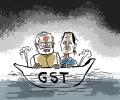
The Directorate General of GST Intelligence (DGGI) has uncovered a fake input tax credit racket worth approximately 593 crore in Karnataka, leading to the arrest of the alleged mastermind.
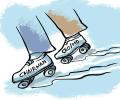
India is the second-most-preferred destination among chief executive officers planning international investments - up from the fifth spot last year, according to PwC's 29th Annual Global CEO Survey released on Tuesday. The United States is their first choice.

Like the realisation on the failure of development, we have also internalised the failure on democracy, argues Aakar Patel.

'The West Asia or the Gulf crisis has shown that what we develop as national infrastructure when things are not as bad as they could be, we forget to plan for adversities.'

A trends study conducted by India's Financial Intelligence Unit (FIU) has expressed suspicion that cryptocurrency is being used across the country in serious criminal acts like terrorist financing, fuelling secessionist activities, cybercrime, narcotics trafficking, illegal betting and gambling. The report, which was based on suspicious transaction reports and operational analysis, shared these trends and credible intelligence with law enforcement agencies.

The purge in Washington does not pause the war. Strikes continue, Hormuz remains closed, and Brent crude is still dancing around $109 a barrel. For India, the command chaos in the Pentagon is another layer of uncertainty piled on five weeks of conflict that was already straining every buffer Delhi has.

'Without ground troops the US will not be able to oust the Iranian Islamic regime. Political change does not happen just by using bombs or planes.'

'The next two to three weeks will not be decided in Washington.' 'They will be decided in Tehran, in whatever calculation Iran makes about the costs of continued resistance against the costs of appearing to have yielded.'

Trump has made it clear: the US will not lift its blockade of Iranian ports until a deal is signed.

'We are profoundly energy-dependent on the Gulf. That dependency must now be redirected towards the United States, because we require American permission to procure oil.' 'We additionally require Iranian permission to acquire oil from that source. So India now has to seek two separate permissions merely to secure its energy supply.' 'Should we be compelled to source from America, or from Venezuela -- which is, in effect, American-controlled supply -- that will inevitably carry a price premium, an elevated shipping cost, and a considerably extended delivery timeline, given the distances involved.'
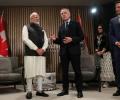
The statement suggests that Canadian authorities do not see ongoing foreign interference or violent activity tied to India at present.

Taking Kharg would give the US control over virtually all of Iran's oil exports and thus provide significant leverage, notes Prem Panicker in his must read daily blog on the Gulf War. It would also put American troops within range of Iran's remaining missiles, drones, and artillery on a piece of real estate that is just eight square miles in size, and just 15 miles from the Iranian mainland.

Iran is fighting a different war: Older, slower, and in some ways more dangerous. Iran doesn't need to shoot down an F/A-18. It only needs to make the Strait of Hormuz feel dangerous long enough for insurance markets, shipping companies, and oil futures traders to do the rest. Prem Panicker continues his must-read daily blog on the war in the Middle East.

By all available indications, the White House drafted a face-saving note and handed it, ready-made, to Islamabad. Pakistani Prime Minister Shehbaz Sharif was supposed to then post it in the guise of a plea urging Trump to extend the deadline by two weeks 'to allow diplomacy to run its course'. Trump would then graciously accept Pakistan's 'request' and declare a ceasefire. Sharif dutifully posted the message on X. Except that he, or whoever was handling the account, forgot to delete the tell-tale first line visible in the edit history: 'Draft - Pakistan's PM Message on X'. Prem Panicker's must read blog on the Iran War.

The core issues to be settled -- access to Hormuz, Israel's aggression in Lebanon, the question of Iran's nuclear programme, sanctions relief and compensation -- are thorny enough to require weeks of patient negotiation. The most likely outcome of the opening sessions is that both sides take the measure of each other, establish what is and is not negotiable, and return home without having broken anything. That would count as progress.

India and Israel have elevated their relationship to a special strategic partnership, focusing on enhanced cooperation in trade, technology, and defense, while also addressing regional peace initiatives.

'If movement remains stalled for three to four months, more than 300,000 recruitments from India could be affected.'

Israel has for more than two decades and several US presidencies worked to draw the United States into a full-scale war with Iran. Having finally achieved that, the last thing it wants is Trump declaring victory and going home, as he is prone to do. Ali Larijani was the figure most capable of handing Trump a negotiated exit with something to show for it. Without Larijani, the road to an exit gets considerably narrower. Prem Panicker continues his must read daily blog on the Gulf War.

IMF Managing Director Kristalina Georgieva discusses the potential of artificial intelligence to boost global growth, particularly in India, while also addressing the significant risks of job displacement and financial instability.

Officials said the digital ban was intended to disrupt ideological channels that facilitate cross-border radicalisation, particularly in areas where socio-economic vulnerabilities are exploited by extremist networks.

The Indian government informed Parliament that India and the US are engaged in negotiations for a mutually beneficial multi-sectoral bilateral trade agreement. The two countries also cooperate on strategic, economic, and defense matters, managing divergences through high-level dialogues.

The ceasefire is still technically holding, to the extent that no overt hostilities have been reported yet, but the rhetoric has hardened dangerously. The week ahead will also clarify whether the Islamabad failure was a negotiating tactic or whether Washington has genuinely locked itself into a position from which the only exits are climb-down, escalation, or the slow bleed of a new status quo that nobody chose and nobody controls. Prem Panicker continues his must read blog on the Iran War.

There is record underperformance and under-ownership. Some of this is cyclical and will turn on its own. However, we also need to regain our growth credentials. For this, both the government and companies have a role to play, as do investors, points out Akash Prakash.

Alliances fight wars effectively only when they share an endgame. If Israel acted without US knowledge, then the military alliance is operating without real coordination at the level of strategic targeting. Neither picture is reassuring in a war that is no longer regional in its consequences. Prem Panicker continues his must read daily blog on the Gulf War.

The LPG squeeze on India's restaurant sector is the quotidian face of a deeper crisis.

Egypt, Pakistan, Saudi Arabia and Turkey met in Islamabad in what analysts say is the formal opening of a new diplomatic formation that could reshape the post-war regional order. Their immediate goal is a ceasefire; their larger ambition is to ensure that neither Iran nor Israel emerges from this war in a dominant position. Pakistan's foreign minister then flew directly to Beijing and mooted a Chinese role as guarantor of any eventual agreement. Prem Panicker continues his must read daily blog on the Gulf War.

'The real risk is not that AI will fail to transform India's economy.'
'The risk is that it already is -- while our measurement systems continue to look the other way,' observes Nishant Sahdev, a theoretical physicist at the University of North Carolina.

What we are watching is something different: A fog manufactured and maintained by the people who started the war, so that the question of why it was started never has to be answered, observes Prem Panicker in his must read blog on the war in the Middle East.

The delegations from the US and Iran head to Islamabad on Friday, carrying a ceasefire that is already fraying, a Strait that is technically open and practically closed, and a negotiating agenda that would challenge even parties actually negotiating in good faith, which these groups are not. Prem Panicker continues his must read blog on the Iran War.

'The (Maoist) organisation is in visible decline. Their senior leaders are ageing. Forest life is unforgiving -- older leaders simply cannot cope physically.' 'Earlier, they attracted educated youth from cities. That stream has dried up. Today's recruits largely come from poor village backgrounds and lack ideological depth.'

'No one can or will bar India from pursuing its energy goals as it wishes.' 'The US FTA wording may sound more restrictive, but the underlying reality will not undermine India's sovereign energy decisions.'
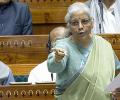
Finance Minister Nirmala Sitharaman launched a strong attack on Rahul Gandhi and the Congress party, accusing them of compromising India's interests on the world stage and selling out farmers and the poor during their time in power.
The Centre is regularly holding consultations with stakeholders to streamline foreign direct investments (FDIs) and foreign institutional investments (FIIs) related processes to enable faster and more efficient investment flows into the country, said Commerce and Industry Minister Piyush Goyal, adding one such meeting with stakeholders was held on Tuesday.

Union Home Minister Amit Shah emphasizes the need for a unified anti-terrorism structure and a strong anti-terrorism grid across India to effectively counter terror attacks. He also announced a new plan to combat organized crime.

Strong performance in the beauty and personal care (BPC) segment, margin gains, and expectations of a breakeven in the fashion business lifted sentiment for FSN E-Commerce Ventures (Nykaa). The consumer technology platform's stock rose 7.5 per cent on Friday, extending gains over the past week to more than 17 per cent. Most brokerages have upgraded the stock following its third-quarter (October-December/Q3) performance and higher profit expectations ahead.

Fight on toward goals that keep receding, or exit with most objectives unmet. Trump is agitated, his poll numbers falling below the Plimsoll line, his base fractured between those who back the war and those who remember that he campaigned on ending them.

RSS chief Mohan Bhagwat addressed concerns about population imbalance, citing religious conversion, infiltration, and low birth rates as key factors. He advocated for 'ghar wapasi' and vigilance against infiltrators, while also emphasizing the importance of family and employment.

India emerged from the war militarily bruised and strategically altered. The United States, under the guise of friendship, had succeeded in achieving what open alignment never could: The psychological and political repositioning of India within the Cold War order, points out Dr Kumar.
